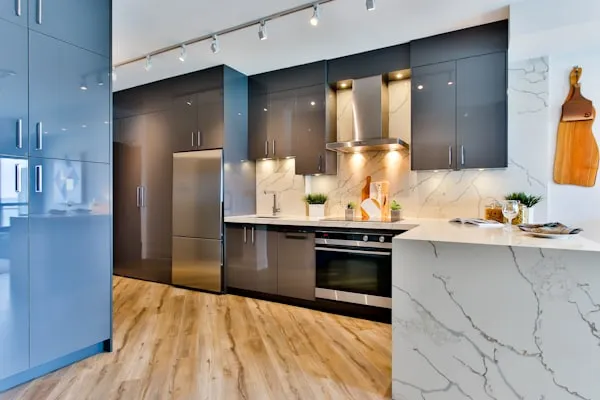
Most construction projects face material cost overruns. When the numbers come in over budget, the standard response is to cut specs. Swap the porcelain for ceramic. Downgrade the quartz to laminate. Replace the specified lighting with builder-grade alternatives. The result is predictable: conflicts with the design team, a lower-quality building, and a finished product that falls short of what was promised to investors or tenants.
There is a better approach. Instead of changing what you buy, change what you pay for it. The global market for construction materials is far more competitive than most project teams realize, and the pricing gaps between equivalent products are significant. This article lays out seven strategies for reducing material costs by 20-50% while keeping every specification intact.
Why Construction Material Costs Are Higher Than They Need to Be
Before jumping into the strategies, it helps to understand why material costs end up inflated in the first place. The root causes are structural, and they affect nearly every commercial construction project.
Specs default to well-known brands. When designers write specifications, they typically call out products from established brands they know and trust. That makes sense from a quality assurance perspective. But those brands also carry significant price premiums. A name-brand porcelain tile and a lesser-known manufacturer’s tile can share identical performance ratings while differing in price by 40% or more.
Limited sourcing means limited price competition. Most project teams work with a small network of distributors and reps. They get pricing from the same three to five sources on every project. Without broader market coverage, there is no mechanism to discover that the same spec can be fulfilled at a fraction of the cost from a manufacturer the team has never worked with.
Nobody compares landed costs across the full market. Even when teams do look at alternatives, they often compare catalog prices rather than total delivered costs. A product that appears 30% cheaper on paper may only be 10% cheaper once freight, duties, and handling are factored in. Without a true landed-cost comparison, savings estimates are unreliable.
Most teams check 2-3 suppliers when hundreds exist. For any given interior finish specification, the global market includes dozens to hundreds of manufacturers producing equivalent products. Checking two or three options barely scratches the surface. The real savings live in the long tail of the market, where competitive manufacturers offer identical performance at substantially lower prices.
7 Strategies to Reduce Material Costs
1. Break Specs into Performance Attributes
The single most important shift in construction procurement is to stop thinking in brand names and start thinking in performance requirements. Every specified product can be decomposed into a set of measurable attributes that define what it actually does.
Take a tile specification as an example. A typical spec might read “Brand X 24x48 Polished Porcelain.” That sounds specific, but it is actually describing a set of performance characteristics: porcelain body, PEI Class 4 hardness rating, 24x48 inch format, rectified edges, polished surface finish, and water absorption below 0.5% per ASTM C373.
Once you define this performance fingerprint, the specified brand is no longer the only option. You can search the entire market for any product that matches every attribute. The brand becomes irrelevant. The performance is what matters.
2. Source Beyond Your Usual Suppliers
Most project teams operate within a familiar network of three to five distributors. These relationships are comfortable and reliable, but they also limit the pricing landscape. When every project goes to the same suppliers, there is no price discovery happening.
The global market for interior finishes includes hundreds of manufacturers across dozens of countries. Many of these manufacturers produce products that meet or exceed the performance attributes in a typical specification, at prices 30-60% below the specified brand. The challenge is not whether these products exist. It is finding them efficiently.
Expanding the sourcing network is where the largest savings consistently appear. Learn how broader market coverage works in practice.
3. Compare Landed Costs, Not Catalog Prices
A product that costs 40% less at the factory may cost nearly the same once you account for freight, import duties, and handling. Catalog price comparisons are misleading. The only number that matters is the total delivered cost to the jobsite.
A proper landed-cost comparison should include every component of the total expense:
- Product cost: the unit price from the manufacturer or distributor
- Freight: transportation from the factory or warehouse to the project site
- Import duties: applicable tariffs for products sourced internationally
- Handling: warehousing, palletizing, and last-mile delivery charges
- Minimum order premiums: surcharges for orders below a manufacturer’s minimum threshold
When all of these costs are accounted for, the true savings picture becomes clear. Some alternatives that look compelling on a price sheet fall apart. Others that seem modest actually deliver strong savings because their logistics are efficient.
4. Start VE During Design Development
The timing of value engineering has a direct impact on how much savings are achievable. The earlier you start, the more flexibility exists and the more options are available.
During design development (DD): This is the ideal window. Specifications are still being written. There is full flexibility to evaluate alternatives. The schedule allows time for sampling, review, and iteration. Savings potential is at its maximum.
During construction documents (CDs): Some flexibility remains, but timelines are tighter. Specifications are more locked in, and changes require more coordination with the design team. Savings are still meaningful but narrower.
During procurement: Options become very limited. Lead times constrain which alternatives are viable. Products need to be available quickly, which eliminates many of the most competitive sources. This is the most expensive time to start looking for savings.
The takeaway is simple: start early. If you wait until procurement to think about material costs, you have already lost most of your leverage. See why early engagement matters.
5. Never Skip the Submittal Process
Every alternative product must go through the full submittal process before procurement. This means physical samples sent to the designer for review, followed by formal submittal documentation for the architect of record.
This step protects the design intent. A product may match every measurable specification on paper, but the color, texture, or visual quality might not align with what the designer envisioned. The sample review catches these issues before they become problems on the jobsite.
Skipping submittals is the fastest way to create rework. A product that arrives on site without designer approval can be rejected, forcing the team to reorder, absorb the cost of the rejected material, and deal with schedule delays. The submittal process takes time upfront but prevents far more expensive problems downstream.
6. Focus on High-Volume, High-Premium Categories
Not every product category offers equal savings opportunity. Some categories have thin margins and limited manufacturer competition. Others have wide pricing gaps between brands and deep markets of alternative producers.
Based on real procurement data, these categories consistently offer the largest cost reductions through value engineering:
- Porcelain tile: $7.25/sf specified, $3.70/sf alternative (49% savings)
- Quartz countertops: $34/sf specified, $13/sf alternative (62% savings)
- SPC/LVT flooring: $2.40/sf specified, $1.40/sf alternative (42% savings)
- Lighting fixtures: 30-40% savings typical on decorative and functional lighting
- Interior doors: 40-50% savings on hollow-core and solid-core doors
Prioritizing these high-impact categories means the VE effort is focused where the return is greatest. A team that spends its time optimizing these five categories will capture the majority of available savings on most commercial projects. Explore the full range of product categories.
7. Use Technology to Search at Scale
Manual value engineering is limited by the number of phone calls, emails, and catalog reviews a procurement team can handle. A typical team might evaluate five to ten alternatives for a given specification. That is better than nothing, but it barely covers the available market.
AI-powered procurement technology changes the math entirely. Instead of evaluating a handful of options, technology platforms can search hundreds of manufacturers simultaneously, matching products against the performance fingerprint defined in the spec. The result is broader market coverage, better pricing, and a faster turnaround than manual VE could ever achieve.
The difference between checking five suppliers and checking five hundred is not incremental. It is the difference between finding a modest discount and discovering that the market price for a product is half of what the specified brand charges.
What These Savings Look Like on Real Projects
On a 101-room Kimpton hotel project, Maverick Development saved $45,000 on a single tile specification through value engineering. The alternative tile matched the original's dimensions, PEI rating, water absorption, and aesthetic. The only thing that changed was the price.
That result on one product line is striking, but the full picture is even more compelling. Across all interior finish categories on a typical commercial project, savings of 20-50% are standard when the full market is evaluated.
To put that in concrete terms: for a project with a $5M interior finish budget, value engineering can return $1M to $2.5M to the budget. That is money that can fund amenity upgrades, cover contingency, improve the building’s competitive position, or flow directly to the bottom line.
These savings are not theoretical. They come from real procurement data on real projects, delivered through a process that maintains full spec compliance and designer approval at every step.
Getting Started
The first step is understanding how much savings potential exists in your current specifications. Every project is different, and the savings depend on the product mix, quantities, and how the original spec was written.
The fastest way to find out is to request a free VE report. Submit your finish schedule and specifications, and you will receive a line-by-line analysis showing which products have competitive alternatives, what those alternatives cost on a landed basis, and the total savings available for your project.
There are no commitments involved. No products are substituted without your explicit approval. No changes are made to the design without the designer signing off through the submittal process. The report simply gives you data to make informed decisions about where to spend and where to save.
If you are working on a project where material costs are a concern, the question is not whether savings exist. They almost certainly do. The question is whether you have the market visibility to find them.